
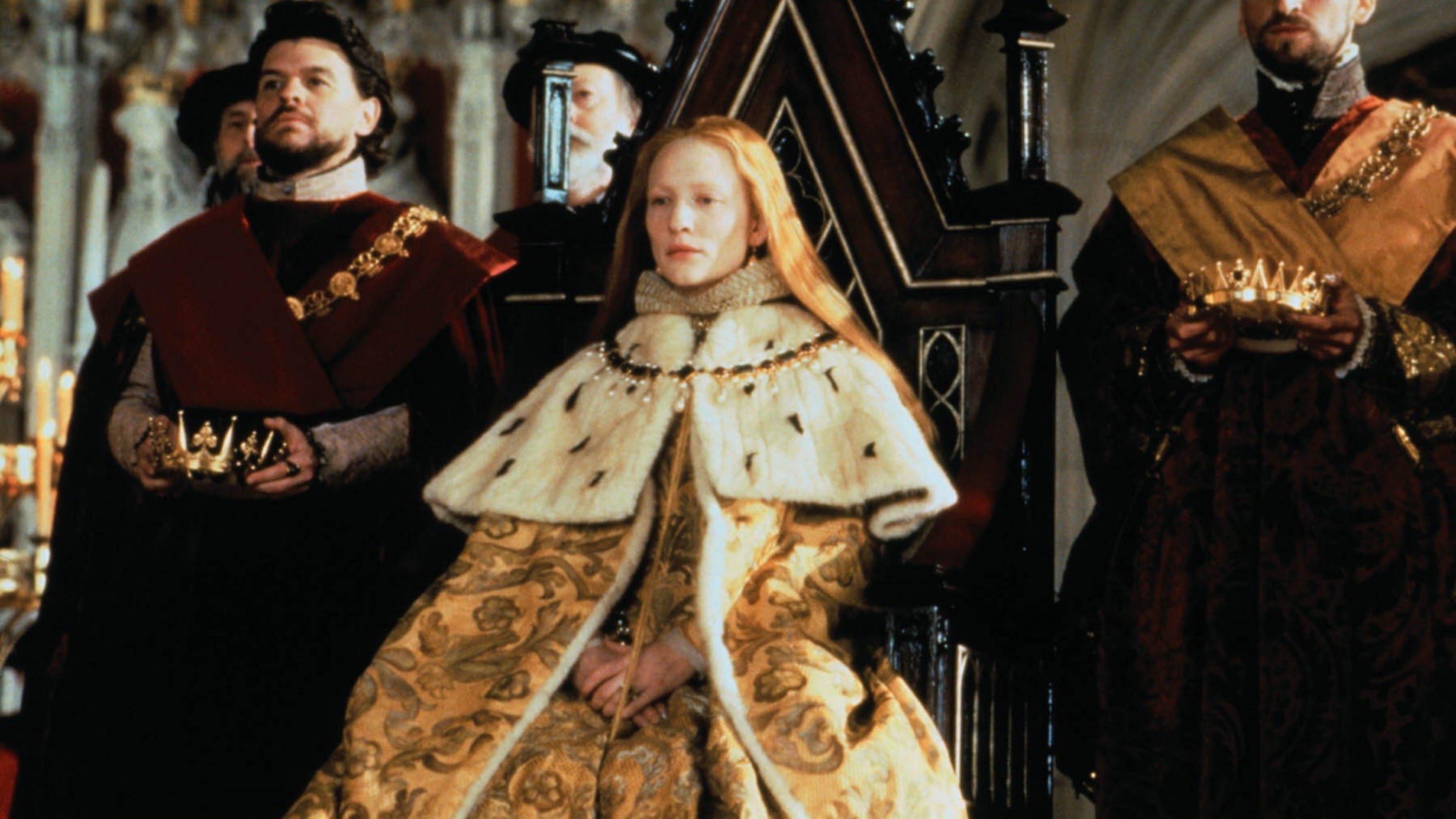
OK, we’ll do this again.
I was rewatching 2023’s Firebrand, a film about the last years of Henry VIII but placing his sixth and last wife, Katherine Parr, as the protagonist. The essential storyline of the film is that Katherine, who has been acting as an efficient and benevolent regent while the raging psychotic who wears the crown was on campaign in France, is full of enlightened Protestant or quasi-Protestant beliefs about personal autonomy and intellectual liberty, whereas the King, if believes anything at all, is under the influence of sinister, repressive Catholic counsellors like Stephen Gardiner, Bishop of Winchester; the Queen juggles this with being a jolly nice stepmother to Henry’s three surviving children, Edward, Mary and Elizabeth, who will all be monarchs in that order (though in age order from oldest they are Mary, Elizabeth and Edward but male primogeniture).
Firebrand, directed by Brazilian film-maker Karim Aïnouz, received mixed reviews when it was released. I don’t intend to review it per se but I will say that it’s a strong cast with some fine performances: Alicia Vikander and an almost-unrecognisable Jude Law are very good as Katherine (or Kateryn, as she tended to spell her name) and Henry; Sir Simon Russell Beale dependably gives it maximum bananas as Bishop Gardiner without ever becoming quite a pantomime villain; Junia Rees is appropriately impressive, precocious and annoying as Princess Elizabeth; and Eddie Marsan, if you can discern him behind an enormous false beard, is perfectly fine as Edward Seymour, Earl of Hertford, afterwards Duke of Somerset and Lord Protector.
Sam Riley as Hertford’s brother Sir Thomas Seymour seems a little like he’s waiting for the sequel that never comes: after Henry’s death and the accession of the nine-year-old Edward VI, Hertford/Somerset takes control of the Council for a time, and younger brother Thomas is ennobled, becomes Lord High Admiral, marries Queen Kateryn and probably sexually abuses Princess Elizabeth, then 14. Least said, soonest mended; by March 1549 he’s been executed for treason (and Kateryn has died at the age of 36 after giving birth to her only child).
Erin Doherty, then fresh from her turn as Princess Anne in The Crown, is as exasperating, hectoring and smug as heretical preacher Anne Askew probably really was. Please note, this is not an endorsement of judicial torture of men or women, though Askew stands as the only woman known to have been both tortured in the Tower of London and burned at the stake, at Smithfield. She was racked repeatedly, first by the Lieutenant of the Tower, Anthony Knyvett, then, when he was queasy at proceeding, by the Lord Chancellor, Lord Wriothesley, and former Speaker of the House of Commons and future Lord Chancellor Sir Richard Rich. Both men personally turned the wheels of the rack, wrenching Askew’s joints apart, and she was unable to walk to her execution. It’s questionable, for many reasons, whether this use of the rack was legal, but we are where we are and neither Wriothesley nor Rich, lawyers both, seem to have had any compunction.
It’s a good-looking film, shot at Haddon Hall in Derbyshire, and I don’t say that solely because my friend Carolina was the gaffer for the production, although she was. As I say, some of the performances are extremely good: Law fills the screen as the bloated and ulcerous Henry, who was, it’s important to remind oneself, only 55 when he died: the same age as, say, Justin Trudeau, Ewan MacGregor, Mark Wahlberg or David Tennant are now. Vikander is rather glum and dour, which is not the depiction of Kateryn we are able to construct from what relatively little we know, but Junia Rees is convincing as Elizabeth, if about five years too old for the role given that she’s playing a girl of 12 or 13.
The story is another… story. The script was written by twins Henrietta and Jessica Ashworth, and is based on Elizabeth Fremantle’s 2013 novel Queen’s Gambit. In fairness, let me say that I haven’t read the book—I read very little historical Tudor fiction—so I have no idea how much of the narrative is Fremantle’s and how much the Ashworths’. The Ashworths worked on Killing Eve and claim to be obsessed with psychopaths, and I suspect we’re supposed to drop late-stage Henry lazily into the basket bearing that label, which is sloppy historiography. But, to be clear—and I accept this is a drama, a work of fiction, a story to be enjoyed, all of that—large chunks of the narrative… well, never happened.
I won’t go through the film frame-by-frame, but just to point to a few examples: Kateryn Parr and Anne Askew were not childhood friends, Parr was about nine years older than Askew and the two never, so far as we are aware, even met. The Queen was not at any point imprisoned in preparation for trial or execution. She was sympathetic to Protestantism, and viewed with suspicion for that reason by Gardiner and Wriothesley, and in 1546 they went so far as drawing up a warrant for her arrest, but Kateryn saw the warrant before Wriothesley attempted to serve it and she easily outmanoeuvred both men with the King.
Nor was she an isolated voice or battling against the odds in the King’s Council during her regency: she had personal authority as Queen Regent, but also a number of allies including the Earl of Hertford; her uncle Lord Parr of Horton, Chamberlain to the Queen and appointed to the Council at her request (though too ill to attend); and the Archbishop of Canterbury, Thomas Cranmer (who is curiously absent from the entire film). She also had a good relationship with the Earl of Shrewsbury, Chamberlain of the Exchequer and a powerful figure in Northern England, later as Justice in eyre north of the River Trent.
That the Queen had been left as Regent while Henry was on campaign in France was not some shocking proto-blow for sexual equality: his first wife, Katharine of Aragon, had been an extremely effective Regent for several months in 1513 and had overseen the devastating defeat of the Scottish army and the death of the King of Scots, James IV, at the Battle of Flodden; Philippa of Hainault had acted as Regent in 1346 when Edward III was, yes, away on campaign in France; Eleanor of Provence had been Regent for he husband Henry III (away in France, of course) in 1255; the formidable Queen Eleanor of Aquitaine had been Regent several times both for her husband, Henry II, and her son Richard I; Queen Matilda had stood as Regent for Henry I at least four times in the early 1100s; Queen Ælfthryth had acted as Regent during the minority of her son Æthelred II (remembered as “the Unready”) from AD 978 to around AD 984. It was entirely standard practice, but in no way read across to the idea of a female monarch in her own right, a queen regnant, which when it eventually came about in 1553 was fraught with challenges (I talked about this in a podcast/essay last year).
Certainly, there is no evidence that Kateryn choked Henry to death, either to save herself or to usher in a reign of religious freedom and tolerance. The King may only have been in his mid-50s but his health for the last six or seven years of his life at least was dreadful: he was massively overweight, the wound on his leg sustained in a jousting accident in 1536 never healed and was regularly infected and suppurating, he may have gout and various other ailments have been proposed, including scurvy and McLeod syndrome. Suffice to say that his demise did not come as a great shock to the courts of Europe; and his father, Henry VII, had died aged 52 of tuberculosis. Henry VII’s uncle, Jasper Tudor, Duke of Bedford, had only lived to 62 while his father Edmund, Earl of Richmond, had succumbed to plague aged 26, so there was a paucity of longevity in some branches of the Tudor family tree.
How important you think any of this is remains a matter of taste: Firebrand is not a documentary, but it does not present itself as wholly fictional either. Where I think the film goes completely wrong in a significant way, however, is in a monologue voiced by Elizabeth at the end, reflecting on the Queen’s “hastening” of Henry VIII’s death.
It was in no one’s interest to question what had happened. My father’s dark heart was deemed to have stopped. Overcome by poison from his ulcerating leg. His death was kept secret for more than a week, while the men around him fought over the bones of his will. His tomb fell to decay and was lost for 100 years. After my father’s death, Katherine published her most daring book of prayers. It laid the foundations for a new faith. Open and tolerant. There is more than one way to scorch the earth. She forged something in her flames... and made way for the tender shoots of hope to burst forth.
In fact there had been almost obsessive planning for Henry’s death, admittedly with the King’s mind swinging this way and that. The Succession to the Crown Act 1533 had declared Elizabeth heir presumptive and Mary a bastard, the Succession to the Crown Act 1536 had then excluded Elizabeth too and given the King authority to name a successor in his will (it was passed before the birth of Edward VI), while the Succession to the Crown Act 1543 had restored Mary and Elizabeth to the line of succession behind Edward. Henry’s will in the terms extant when he died named 16 executors to act as the new King’s council until he was 18, as well as 12 men “of counsail” who would advise and assist the executors as necessary.1 There was no provision for a single regent or protector, the council of 16 intended to rule collectively, by majority decision, “with like and equal charge”.
There have been suggestions that the will was altered without Henry’s knowledge in the last weeks of his life, though the general feeling now seems to be that too mcuh has been made of this. The succession was in fact smooth and orderly, and according to the King’s instructions; although the appointment of Hertford, created Duke of Somerset, as Lord Protector a few days after Henry’s death was not a provision of the will, it was done with the assent of 13 of the 16 executors, who were intended to govern by majority decision; it was also entirely in accordance with precedence to appoint a single protector or regent during a minority, and Somerset was a successful military leader, now occupied the highest level of the peerage and was the new King’s uncle. Was this “the men around him fighting over the bones of his will”? Really there was very little fighting. Generally it was as Henry had anticipated.
Elizabeth’s monologue also mentions that Kateryn published “her most daring book of prayers”. It is true that in November 1547, The Lamentacion of a Synner, a three-part work of reflections on spirituality, was published and was the first book published in English and in England by a woman under her own name. It was undoubtedly a significant work which has long been rather underestimated. But to suggest it “laid the foundations of a new faith” is simply laughable. The guiding spirit of Edwardian Protestantism, if there was a single figure, was surely Archbishop Cranmer, who had an international network of correspondents which included Martin Bucer, Pietro Martiro Vermigli, Bernardino Ochino, Paul Fagius, Jan Łaski, Philipp Melanchthon, Friedrich Myconius, Andreas Osiander, Heinrich Bullinger and John Calvin. He had met some of the leading German and Swiss reformers more than 15 years before.
Moreover Cranmer was the author of The Book of Common Prayer, one of the foundational texts not only of the Church of England but the English language, The Homilies, A Defence of the True and Catholic Doctrine of the Sacrament and the Forty-Two Articles of 1553, the official doctrinal stance of the Church of England on which were based the Thirty-Nine Articles of Religion, finalised in 1571 and still adhered to by the Church today. Cranmer’s thought and words run through Anglicanism like an ineradicable thread. Queen Kateryn’s book, however significant and thoughtful, does not.
The most absurd part of the closing monologue, however, is that Queen Kateryn’s works were used by Henry VIII’s predecessors, and especially Elizabeth, to bring about a religious settlement that was “open and tolerant” and “made way for the tender shoots of hope to burst forth”. That is not only demonstrably false, it is also an ambition none of Henry’s children, not Edward VI nor Mary I nor Elizabeth I would have realised as desirable or achievable.
“Toleration” was not at this stage regarded as an inherent virtue, let alone a positive civic dynamic. It was not unknown, of course; the Edict of Nantes, for example, signed by Henry IV of France in April 1598, granted considerable tolerance to the country’s Calvinist Huguenot communities in a predominantly Catholic public space. But the privileges granted to Huguenots were circumscribed: theyn could practice their faith openly, but only in certain geographical areas, and could hold public office and establish their own institutions of learning. But France remained a Catholic country, Huguenots were not exempt from tithes—taxes paid to the Church—and they were required to observe Catholic holidays and conditions of marriage. Most importantly, however, the Edict of Nantes was an act of mediation, of compromise, an attempt to bring to a close the bloody religious strife which had wracked France since 1562. It would be revoked by Louis XIV in 1685, but it had never been regarded as a full and final settlement: Catholics did not accept that Protestantism should be a permanent feature of French life and society, while Protestants sought full legal equality and freedom of worship and conscience, which the Edict did not provide.
But sixteenth century society did not even see such equality and diversity as an inherently good or stabilising force. Elizabeth I herself, for all that the actress portraying her mouths these inanities, understood this very well. Her own private theological and doctrinal beliefs, like those of her father’s, are complex, internally contradictory and often hidden from view. She kept a crucifix, which many Protestants damned as idolatry, in her own chapel but allowed them to be removed from churches; her Chapel Royal maintained more elaborate items like candlesticks and crosses which would have smacked of popery elsewhere; she disliked the idea of bishops marrying; and her settlement for the Church of England allowed the use of vestments.
The Act of Uniformity 1558 allowed a degree of latitude between conservatives and evangelicals in an attempt to find a via media, the effect of which is the slightly strange nature of Anglican worship and theology even today, but the word “uniformity” was significant. Elizabeth famously, if probably apocryphally, said that she had no desire “to make windows into men’s souls”, but Elizabethan Englishmen and women were required to attend church on Sundays and holy days or face a fine of 12 pence, about three days’ wages, and to participate in the services. This was the heart of the matter: what Elizabeth wanted was publicly demonstrated outward conformity. What people truly believed was to her of much less importance, and she likley understood it was impossible to police, but she understood that a society which acted in conformity with rules was a peaceable and an orderly one. Oderint dum metuant, Caligula had been fond of saying, let them hate so long as they are afraid; Elizabeth I might reasonably have construed her motto as Cogitent dum pareant, let them think, so long as they obey.
One final piece of slapdash philosophy is the implication that Catholicism is inherently authoritarian and repressive, while Protestantism is by its very nature pluralist, permissive and diverse. Perhaps this stems from a (very mistaken) belief that all Protestants regarded each other with fraternal tolerance as comrades in the war against Catholicism. That was hardly so: it was disputes within Protestantism, indeed within Anglicanism, that drove the Puritans to leave England for the New World in the 17th century—and those Puritans were not seeking to create a world where anyone could worship as they wished. They wanted freedom to practice their own very specific interpretation of Protestantism, and had absolutely no time for anyone else’s.
We can see how this playd out in England’s brief experiment with republican government between 1649 and 1660. During the era of the Commonwealth, theatres, which had been closed temporarily in 1642, were declared permanently closed by a 1647 Ordinance for the Lord Major and City of London, and the Justices of Peace to suppress Stage-playes and Interludes then, a few months later, in February 1648, an Ordinance for the utter suppression and abolishing of all Stage-Plays and Interludes, within the Penalties to be inflicted on the Actors and Spectators therein expressed. In June 1647, an Ordinance for the Abolishing of Festivals banned traditional celebrations of Christmas, Easter and Whitsun, replacing them with “a convenient time allotted to Scholars, Apprentices, and other Servants for their Recreation”. The adoption of the Westminster Confession of Faith in 1647 imposed strict observance of the Sabbath, Chapter XXI declaring:
This Sabbath is the kept holy unto the Lord, when men after a due preparing of their hearts, and ordering of their common affairs beforehand, do not only observe a holy Rest all of the Day, from their own words, works, and thoughts about their worldly employments, and recreations, but also are taken up the whole time, in the publike and private Exercises of his Worship, and in the duties of necessity, & mercy.
These stringent moral limitations were placed by one group of Protestants upon another, in a country in which Catholicism had more or less ben eradicated as a significant demographic force.
That is the final nail in the coffin of an “open and tolerant” polity. Catholicism after 1558 was not simply no longer the religion of the state, it was persecuted and attempts made to eradicate it wherever possible, especially after 1570. Mary I is remembered by history as “Bloody Mary” because 313 people were put to death for heresy over the five years of her reign, but it is estimated that something like 430 Catholics died for their faith between 1534 and 1544, and another 300 or so were executed by Elizabeth I. To Henry’s tally must be added hundreds, probably thousands more heretics, both Catholic and Protestant, who were executed for treason or simply part of summary executions and reprisals after religiously inspired rebellions and uprisings. In the aftermath of the Pilgrimage of Grace of 1536/37, a serious threat to Henry VIII’s authority for which traditional Catholicism was a powerful motivating force, at lest 200 people were executed.
This is not particularly a condemnation of Henry VIII, though he was certainly a man for whom capital sentences held no horror. The 16th century was a brutal time, challenges to the established order had to be dealt with severely—especially by a dynasty as shallow-rooted as the House of Tudor, only on its second monarch in Henry VIII—and a challenge to the religious settlement often became a challenge to the established order.
The point is careless, anachronistic thinking, the imposition of today’s values on yesterday. The thought process goes like this: we value freedom of conscience and freedom to practice religion (although do we? Sometimes I wonder); therefore freedom of conscience and freedom to practice religion are good; good people in the past must also have valued freedom of conscience and freedom to practice religion; people in the past who sought to prevent freedom of conscience and freedom to practice religion must therefore be bad. So we end up with the childish and misleading caricature of sinister, dogmatic Catholics—Stephen Gardiner had trimmed his doctrinal sails sufficiently still to be Bishop of Winchester in 1547, remember—attempting to do harm to liberty-loving, diversity-promoting Protestants.
That’s bad history and bad ecclesiology, likely to prompt misinterpretations of the modern world. But worse than that, it ignores the mental and intellectual reality of Tudor men and women. They did not have a beau idéal of an open, free and pluralist society because they would have regarded it as a recipe for anarchy. Stability and order came through conformity and hierarchy. Social mobility was certainly possible—look at the two great Thomases, Wolsey and Cromwell, the butcher’s boy from Ipswich and the Putney brewer’s son—but it was a stratified society and one which operated on a foundation of obedience and regulation. Elizabeth I, who has more projected on to her than anyone except perhaps her mother Anne Boleyn (about whom I wrote at length), was always acutely aware of that.
The named executors were the Archbishop of Canterbury, Dr Thomas Cranmer; Lord Wriothesley, Lord Chancellor; Lord St John, Lord Steward of the Household and Lord President of the Council; the Earl of Hertford, Lord Great Chamberlain; Lord Russell, Lord Privy Seal; Viscount Lisle, Lord High Admiral; the Bishop of Durham, Dr Cuthbert Tunstall; Sir Anthony Browne, Master of the Horse; Sir Edward Montagu, Chief Justice of the Common Pleas; Sir Thomas Bromley, Justice of the King’s Bench; Sir Edward North, Chancellor of the Court of Augmentations; Sir William Paget, Secretary of State; Sir Anthony Denny, Groom of the Stool; Sir William Herbert, Gentleman of the Privy Chamber; Sir Edward Wotton, Treasurer of Calais; and Dr Nicholas Wotton, Dean of York.
An interesting case study on the 'fluidity' of religious persecution/toleration in the time of Elizabeth I is the life and work of William Byrd, the Court Composer, … and Catholic. (https://www.classical-music.com/features/composers/william-byrd)
I saw Firebrand last year and picked fault with it throughout but still enjoyed it. Jude Law was unrecognisable as the morbidly obese Henry and Vikander was as good as she always is as Katheryn Parr. Cranmer missing was a disgrace and I conpletely agree with your views on Protestantism not being wholly 'brotherly'; never was and still isn't but , I suppose, most of us aren't interested in religion anymore so it's all going on without most of us knowing or caring.