
Nothing.
Seriously, that is the tl;dr response to my self-imposed question, and if you read nothing more you’ve still grasped the basic truth of this week’s pointless electoral contest. But you wouldn’t expect me to leave it at that.
The road to Clacton Pier
Last month, I set out the events leading to Nigel Farage’s decision to disqualify himself from the House of Commons by becoming Steward and Bailiff of the Manor of Northstead, forcing a by-election in his former constituency of Clacton, and to seek re-election in that contest. I stand by my conclusion then, which is that this by-election was—at least in part, perhaps largely—an attempt by Farage to insure himself against any adverse judgement by the Parliamentary Commissioner for Standards, Daniel Greenberg, who has resumed his investigation over the propriety and declaration of donations and gifts.
Announcing his intention to force this elecction, Farage said “I’ve decided that the people of Clacton should be the judges of my actions”. This is obviously absurd and is an attempt to get his retaliation in first, to seek a pre-acquittal from the voters of Clacton as if that was an equivalent of, or superior to, the judgement of the Standards Commissioner. The investigation into Farage is not even complete: it was necessarily suspended when he ceased to be a Member of Parliament, and the Commissioner has now resumed it.
In any event, I would gently suggest that not every voter who participated in the by-election will have read all of the available documentation so far available relating to the allegations against Farage. Let’s be clear, this is about circumventing the standards régime of the House of Commons: it is, as Margaret Thatcher said of picketing at Orgreave Colliery during the Miners’ Strike, “an attempt to substitute the rule of the mob for the rule of law”. Farage was asking the voters to return a verdict on him not based on the evidence of specific allegations against him (of which he may be innocent), but on how they feel about him and his party more broadly. I said in my last essay:
It would be deeply corrosive for a system which has become significantly more robust over the last decade if Reform UK’s leader demonstrated a playbook by which a Member even accused, let alone guilty, of breaching the Code of Conduct could potentially nullify a sanction he or she might be given. That would be a deliberate distortion of the regulation of MPs’ conduct and propriety, a misuse of parliamentary procedures and, most seriously of all, a co-option of the electorate into a trick. Voters would be asked to pull the wool over their own eyes.
It would be nice to think that neither Farage nor anyone else in Reform UK will pray in aid the by-election result if he is deemed to have broken parliamentary rules. It has no bearing and is neither defence nor mitigation. But then, I hope for lots of things that don’t happen in the end.
The by-election result
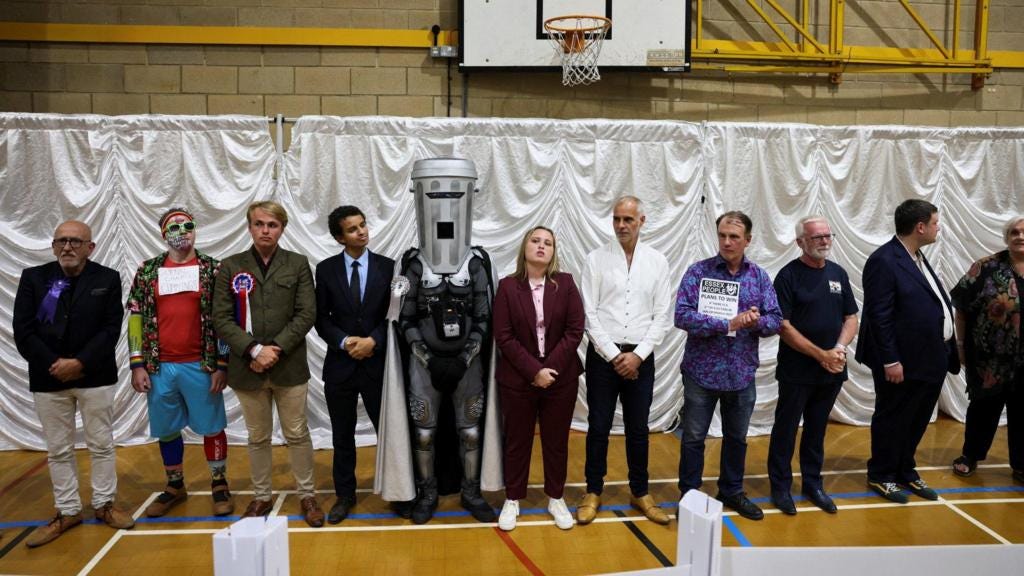
Let’s just look at the actual result of the by-election itself. As happened in July 2008, when Conservative David Davis, having recently resigned as Shadow Home Secretary, created a by-election in his Yorkshire constituency of Haltemprice and Howden, the other parties chose not to oppose Farage in Clacton, trying to minimise any weight or legitimacy the contest might have. Labour, the Conservatives, the Liberal Democrats and the Green Party of England and Wales all decided to stay on the sidelines. This meant that Farage’s most high-profile rival was perennial satirical candidate Count Binface (46-year-old Oxford classics graduate and comedian Jon Harvey, who has written for programmes like Have I Got News For You?, The Thick of It, The Last Leg and Room 101).
It also meant that a Farage victory, initially highly likely, became almost inevitable. During late July and early August, some commentary, perhaps overcome by the succession of heatwaves, tipped from amusing flights of fancy about what might happen if Count Binface were to win the election into overheated ludicrousness suggesting that such an outcome was generally possible. It wasn’t. Farage was as close as possible to being guaranteed a win the moment the other parties stood aside; but even before that, given Reform UK’s strong performance in opinion polls over the past two years, there was very little reason to imagine that Farage’s 2024 majority of 8,405 over Conservative Giles Watling would shrink rather than grow.
(It is worth noting that you can go back to the Representation of the People Act 1832, the so-called Great Reform Act, and, while some Members of Parliament may have given an impression to the contrary, not one evidently “novelty”, “comedy” or “satirical” candidate has ever won a parliamentary by-election. The closest you might get is Edward Kenealy QC, an Irish barrister returned for Stoke-on-Trent at a by-election in February 1875. Although enjoying a successful practice at the Bar, he suffered from extremely erratic behaviour which may be attributable to poorly controlled diabetes: he published translations of poetry from Latin, Greek, German, Italian, Portuguese, Russian, Irish, Persian, Arabic, Hindustani and Bengali, though it is extremely unlikely he was fluent in all these languages; in 1866 he published The Book of God: the Apocalypse of Adam-Oannes, a theological tract in which he claimed to be the “twelfth messenger of God”, descended from Jesus Christ and Genghis Khan; and after he was unsuccessful as counsel in the Tichborne case, during which he had abused witnesses, been disrespectful to the judges and made unsubstantiated allegations against various Roman Catholic institutions and was censured by the jury, he started a newspaper entitled The Engishman to continue to press the case and defame the judges. As a result he was disbenched and debarred by Gray’s Inn, and his appointment as Queen’s Counsel was rescinded. He founded the Magna Charta Association and began a nationwide tour to promote his case. When Kenealy was elected to Parliament, no other Members would stand with him and introduce him, and it was left to the Prime Minister, as Leader of the House, to propose a motion that, for that particular occasion, the requirement to be introduced by two other Members be set aside. Kenealy went on to write a nine-volume history of the Tichborne case and propose a Royal Commission on it, which was defeated in the House of Commons by 433 votes to three. But Kenealy would not have regarded himself as a novelty candidate. Indeed, he suffered from an excess of earnestness.)
Although the main political parties did not contest the Clacton by-election, it featured the highest number of candidates ever recorded in a parliamentary by-election, at 34. Aside from Farage and Count Binface, the candidates were the usual fare of no-hopers, attention-seekers, hobbyhorse owners and people who were willing to spend the £500 required for a deposit simply for the experience (the Official Monster Raving Loony Party inexplicably fielded two candidates). You can judge for youruselves into which category or categories fell the only “famous” name among them, former actor, white supremacist agitator and cautionary tale Laurence Fox, standing under the banner of the Reclaim Party, his self-founded far-right nationalist conspiracy theory support group and cosplay crusader club.
Clacton may have been abuzz but the election campaign failed to catch the public’s imagination more widely. Partly that was due to the inevitability of the result, but, even as we entered the traditional silly season of British politics, it was hard to say what any stories would be about. Polling, always difficult to carry out accurately in a single seat, suggested convincing win for Farage. When it was suggested that she, as then-Chancellor of the Exchequer, deny the Reform UK leader’s application for the Manor of Northstead, the “office of profit under the Crown” it ws necessary for him to hold in order for his place in the House of Commons to be vacated, Rachel Reeves said one of the truest and most resonant things of her public career:
It is a farce and a desperate distraction, and the people of Clacton deserve better. But if he wants to spend the summer arguing with a bin, I won’t stop him.
When the votes were counted, the top six were as follows:
Nigel Farage (Reform UK), 22,239
Count Binface (Binface Party), 9,455
John Stevens (Rejoin EU), 492
Tony Francis (Independent), 432
Pamela Walford (Independent), 371
Laurence Fox (Reclaim Party), 347
So Nigel Farage won the seat he’d vacated, with a majority of 12,784 and 63.3 per cent of the total vote. A clear victory, certainly, and confirmation that he remains popular with the voters of Clacton. He received 21,225 votes in 2024 against a fully competitive field, but for the moment he has nothing to prove in his own constituency.
It should be noted that the turnout was, naturally, much lower than at the general election, at 44.4 per cent; in July 2024 it had been 58.7 per cent, which is in itself disappointly low for a general election, but that seems to be a current and regrettable trend. By comparison, the by-election in Makerfield in June, in which Andy Burnham was returned to the House of Commons after nine years away, saw a turnout of 58.8 per cent; on the same day there was a turnout of 38 per cent in Aberdeen South and 31.4 per cent in Arbroath and Broughty Ferry; in Gorton and Denton in February, where Burnham had hoped to be Labour’s candidate, the figure was 47.6 per cent; and the first by-election of the 2024 Parliament, in Runcorn and Helsby, the turnout was 46.2 per cent.
Reading the runes
It’s difficult to draw too many conclusions from these figures. The two Scottish by-elections were expected to be straightforward Scottish National Party handovers (though in fact Douglas Lumsden, the Conservative candidate, won Aberdeen South comfortably), so voters perceived that little was at stake. By contrast, Runcorn and Helsby was (rightly) seen as an opportunity for Reform UK to beat the Labour Party in its northern heartlands, and indeed Sarah Pochin was just elected with a majority of six. Gorton and Denton had the spice of Andy Burnham as the dog that didn’t bark in the night, and was caused by the resignation of a former Labour minister, Andrew Gwynne, who had been sending abusive and inappropriate messages on WhatsApp. Meanwhile, Makerfield was effectively a referendum on whether Sir Keir Starmer or Andy Burnham should be Prime Minister; in retrospect, a turnout of 58.8 per cent is the lower end of the scale of what one might expect.
Nevertheless, there have been six by-elections in this Parliament so far, and in five of them, including Clacton, a minority of voters have actually participated. Most, sometimes by small margins, have chosen not to cast a vote.
In a written statement—he did not attend the count—Farage claimed this was a convincing result for him and his party.
The verdict is now in, and it is a convincing, overwhelming win, with more votes than we got in the general election of 2024. Today, the voters in Clacton have stuck up two fingers to the entire political establishment.
He did receive more votes than in the general election; 1,014 more, in fact. But Reform UK is doing vastly better in the polls now than it was at the election; two years ago itwon 14.3 per cent of the vote and is now regularly showing support of around 20 per cent and more. So any Reform UK candidate should have outperformed a 2024 contest, and Nigel Farage, by far the party’s most recognisable and popular figure, should have benefitted more than anyone.But the increase was very modest, and the mainstream parties stayed away, reducing the competition.
As for “sticking up two fingers”, not only is a crude, grim, corrosive and destructive framing of our politics, but you might well conclude that the anti-establishment figure was Count Binface. Farage was an Member of the European Parliament for South-East England for more than 20 years, was Leader of the UK Independence Party three times, of the Brexit Party and now of Reform UK. He is a Member of Parliament and his party has led the opinion polls for most of the last 18 months. He has appeared on the BBC’s Question Time over 35 times. Was it an act of civic rebellion to vote for him, or for a comedian promising a windfall tax on “cosy crime novels written (or ‘written’) by celebrities” and a cap on the cost of a Cadbury’s Flake?
One Reform UK councillor, Jaymey McIvor of Epping District Forest Council, claimed that Farage’s victory meant “the establishment is petrified they will be wiped out at the next General Election”. This is delusional. The “establishment”—by which he presumably means the three main political parties—may or may not be concerned about the threat Reform UK poses to some of their vote; as things stand, they ought to be anxious, each in its different way. They may not face being wiped out, but whatever they feel, it owes nothing to the by-election result. Labour, the Conservative Party and the Liberal Democrats did not contest the election, while roughly as many people voted for Nigel Farage as did in July 2024. Arguably, facing a novelty candidate and a slew of anonymous independents, Farage should have polled much better, consistent with Reform UK’s higher support nationally than in 2024.
No change, no challenge, no point—except…
I end where I begin: the result of the Clacton by-election has told us virtually nothing. It has suggested that Nigel Farage is roughly as popular with his constituents as he was two years ago, which you can interpret as an achievement or a failure according to preference. It also tells us that a surprising number of people, 9,455 of them, about 12 per cent of the electorate, were willing to cast their vote for a novelty candidate, though I suspect overwhelmingly they did so in the certainty of a Farage victory and therefore knowing it would have no consequences. Most voters chose not to take part in the by-election at all.
The result says nothing about the state of Labour, the Conservatives, the Liberal Democrats or the Greens, because they were not there. The Liberal Democrats and the Greens were not a factor in Clacton anyway at the general election—they won 4.4 per cent and 4.2 per cent of the vote respectively—and the Labour candidate, Jovan Owusu-Nepaul, was rather distant third behind Reform UK and the Conservatives on 16.2 per cent. Would Farage have drawn away more voters from these parties if it had been a conventional by-election? Perhaps, but this week they surely had a guilt-free excuse to switch to Reform UK, yet the figures suggest at most 1,000 did so. Again, it is impossible to tell, but you can examine logic and likelihoods.
Fraudulent insurance
If I am wrong, I will be as delighted as anyone, but it seems obvious that the only purpose of this by-election was as a crude insurance policy for Nigel Farage if, and it remains if, the Standards Commissioner determines that he has breached the Code of Conduct for MPs. If that is that is the outcome, there are some circumstances under which the Member guilty of the breach can resolve it by rectification, which includes an apology to the House. Otherwise, and if the Member does not accept there has been a breach, the Commissioner will refer the matter to the House of Commons Committee on Standards, currently chaired by Conservative MP Alberto Costa. If the Committee agrees with the Commissioner that the Code of Conduct has been breached, they can impose one of a number of sanctions, from requiring an apology either in writing or on the floor of the House, to the most serious, of suspension or expulsion from the House. Such a punishment would need to be proposed as a motion to the whole House of Commons and agreed to.
The Recall of MPs Act 2015 provides for the constituents of a Member of Parliament who is suspended from the House for at least 10 sitting days or 14 calendar days to initiate a recall petition. If this is signed by 10 per cent of eligible electors in the constituency, the seat is formally vacated and there is a by-election, in which the previous Member is entitled to stand. Equally, expulsion from the House vacates the expelled Member’s seat and requires a by-election in which, again, the previous Member may be a candidate.
So there are circumstances in which an adverse judgement against Farage would vacate Clacton and require another by-election. Various members of Reform UK have already indicated they would contest the validity of this on the grounds that a by-election has just taken place. That would be a blatant attempt by Nigel Farage to subvert and ignore the Code of Conduct and the rules of the House. This week’s vote cannot be assume to have been informed by facts as yet unknown or contested and events which have yet to happen. Farage cannot manipulate the investigation of the allegations against him like a Christopher Nolan film, defying and distorting chronological time.
I fear that is what will happen, however. Reform UK has a solid track record of insisting that any allegations against it are either actually someone else’s fault or the outcome of a conspiracy by the establishment (defined largely as anyone who opposes the party). It is positively allergic to taking responsibility for anything, and the Clacton by-election probably happened as another card in that game. It isn’t, it proves and disproves nothing and Members of Parliament, now more than ever, need to be held to account—all of them.
Farage was playing games by forcing an unnecessary by-election. But, the other main parties also played games by not contesting the seat. Were the people of Clacton not worthy of being given a choice at all? The historically established main parties will decide when an election is to be significant and when not? The people are simply to note and accept their view? Their decision had nothing to do with the potential humiliation and embarrassment of losing badly?
It was an election to parliament and, no matter how occasioned, all parties should have respected that and respected the voters.
I don't think anything can be learnt from Clacton other than to confirm Danton's famous dictum "La plus CA change...".Also of course that there are now 22 k duped morons as opposed to 21 before.Still care in the community was considered a good idea at the time.It was Jacob Rees Mogg who told me that Mongols have the vote.