Explained: how by-elections happen
The process for holding a by-election in Makerfield will begin today, the previous Member already having vacated his seat, but how does it all actually work?

I’m quite aware that my mother’s career in teaching left me with a slightly hectoring paedagogical streak a mile wide, and I’m guilty of answering questions people never asked, or answering them far more fully than the questioner intended or wanted. Two of the advantages of a blog like this, however, are that I can write whatever I want and people are under no obligation to read if they don’t want to, which I think works out very well for all concerned.
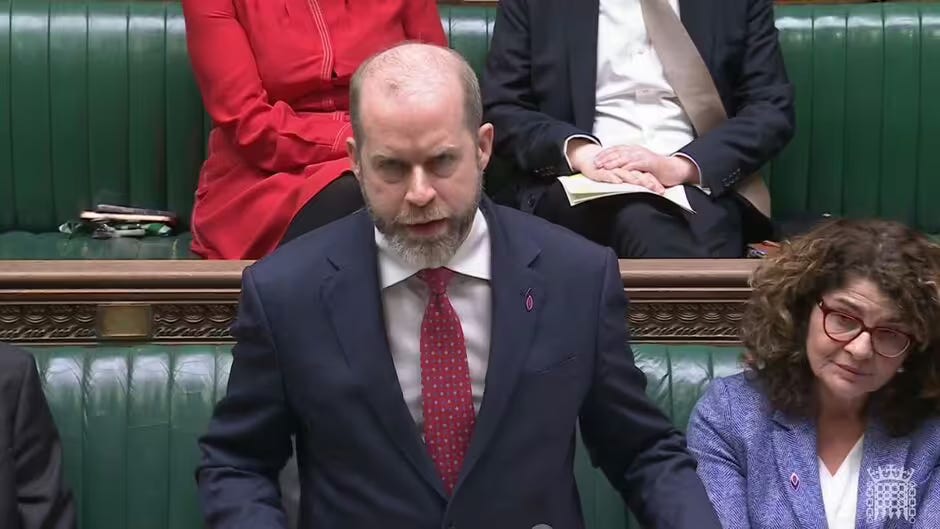
A by-election in the constituency of Makerfield is suddenly looming as the previous MP, Labour’s Josh Simons, fell on his sword yesterday to engineer a contest in which he (and many others) hope that the Labour Party’s candidate will be the Mayor of Greater Manchester, Andy Burnham. More than that, they hope that he wins—I explained recently that I think his victory is very far from certain—and, in the event of his winning, that he goes on to supplant Sir Keir Starmer as Leader of the Labour Party and therefore Prime Minister and First Lord of the Treasury.
There are some quirks in this process and some terminology which is not immediately unambiguous, as well as some simple misapprehensions and lacunae. It is not really so complex a matter but I thought it might be useful for curious readers to have the transition from one Member of Parliament to another set out clearly and, hopefully, intelligibly, and perhaps be able to clear up some misconceptions and—because readers would expect nothing else—offer one or two diverting anecdotes along the way. So consider this a public service and entirely optional.
Leaving the House of Commons
It is a basic tenet of parliamentary procedure and precedent that a Member of Parliament cannot resign from the House of Commons. This is a very long-standing rule, enshrined in a Resolution of the House of 2 March 1624:
Agreed also [a], that a Man, after he is duly chosen, cannot relinquish.
There was a very simple reason for this; in the early 17th century, being a Member of Parliament was at least as much of a burden (and a liability, even a hazard) as it was an honour, and the parliamentary authorities frequently had to chastise MPs for being absent. As the relationship between the House of Commons and the Crown became more oppositional, there were fears that if Members could simply give up their duties then those showing independence of spirit might come under pressure from the King or his advisers to leave the House and make way for more pliant representatives.
The Resolution made it clear that, once you were elected, you were to stay in the role for the length of the Parliament. That need not be very long. In the reign of James I (1603-25), there were only four Parliaments: from March 1604 to February 1611; from April to June 1614; from January 1621 to February 1622; and from February 1624 to March 1625 (the Parliament in which the Resolution was passed). Charles I (1625-49) held three short and unsatisfactory Parliaments then attempted to rule without the legislature, and when his third Parliament was dissolved in March 1629, there would not be another summoned for 11 years.
There have been repeated calls for this apparent anachronism to be addressed and a simple form of resignation to be put in place. It will not surprise readers to know I do not share that view: the mechanism in place, which we will come to in a moment, is hardly complicated or lengthy, and the Resolution stands, 402 years on, as an important reminder of a point I make again and again. Being an MP is not a “job” and it is both impossible and misleading to attempt to compare it to one. It is a thing apart, sui generis, a combination of honour, duty, professional success and burden, and Members will come to no harm of they are occasionally reminded, even if only gently, that they occupy a position of gravity and importance in the governance of the United Kingdom.
Yet, obviously, it is possible to leave the House of Commons other than at a general election, as Josh Simons is doing and as Members do relatively frequently; 16 MPs resigned for a whole host of reasons in the 2019-24 Parliament, two stepped down in the short 2017-19 Parliament, six in the 2015-17 Parliament and 14 in the 2010-15 Parliament. So how was this achieved?
The counterpart to an inability to resign as an MP is a rule that no Member may hold a paid office under the Crown. On 30 December 1680, this was made explicit in another Resolution of the House of Commons:
Resolved, Nemine contradicente, That no Member of this House shall accept of any Office, or Place of Profit, from the Crown, without the Leave of this House, or any Promise of any such Office, or Place of Profit, during such time as he shall continue a Member of this House.
Resolved, That all Offenders herein shall be expelled this House.
Over the centuries there have been many debates about what precisely constitutes an “Office, or Place of Profit, from the Crown”. The Act of Settlement 1701 stated clearly:
That no Person who has an Office or Place of Profit under the King or receives a Pention from the Crown shall be capable of serving as a Member of the House of Commons.
But that provision was not due to come into force until the death of the last Stuart monarch, Queen Anne (which eventually occurred in 1714). In the meantime, the Regency Act 1705 repealed that section of the Act of Settlement and instead modified the list of offices which were held to be disqualifying from membership of the House of Commons.
PROVIDED always and be it further enacted by the Authority aforesaid That from and after the Dissolution or Determination of this present Parliament no Person who shall have in his own Name or in the Name of any Person or Persons in Trust for him or his Benefit any new Office or Place of Profit whatsoever under the Crown which at any Time hereafter shall be created or erected nor any Person who shall be a Commissioner or Sub Commissioner of Prizes Secretary or Receiver of the Prizes nor any Comptroller of the Accounts of the Army nor any Commissioner of Transports nor any Commissioner of the Sick and Wounded nor any Agent for any Regiment nor any Commissioner for Wine Licences nor any Governor or Deputy Governor of any of the Plantations nor any Commissioner of the Navy imployed in any of the Out-ports nor any Person having any Pention from the Crown during Pleasure shall be capable of being elected or of sitting or voting as a Member of the House of Commons in any Parliament which shall be hereafter summoned and holden.
That was again altered by the Succession to the Crown Act 1707. In general, this reiterated the prohibition on accepting of offices of profit under the Crown, and stated that any Member of Parliament who accepted such an office voided his election and a new one would be held. Significantly, however, it made it clear that the person in question could stand for re-election while retaining their office.
PROVIDED always That if any Person being chosen a Member of the House of Commons shall accept of any Office of Profit from the Crown during such Time as he shall continue a Member his Election shall be and is hereby declared to be void and a new Writ shall issue for a new Election as if such Person so accepting was naturally dead Provided nevertheless that such Person shall be capable of being again elected as if his Place had not become void as aforesaid.
This applied to MPs appointed to ministerial office for the first time for the next two centuries (they were not required to go through the process of moving from one post to another). A Member newly appointed to the government would have to stand in a by-election, generally in the seat he had previously held but that was not stipulated. Certainly until well into the 19th century these by-elections were more often than not a formality, the Member frequently returned unopposed, but after the Great Reform Act 1832 they began to be more of a liability and there were occasionally high-profile casualties.
Perhaps most famously, in April 1908, the 33-year-old Winston Churchill, then Liberal MP for Manchester North West was appointed President of the Board of Trade in H.H. Asquith’s new government. In the ensuing by-election, Churchill was defeated by Conservative William Joynson-Hicks—later Home Secretary 1924-29 in Stanley Baldwin’s second government, in which Churchill was Chancellor of the Exchequer—by 429 votes. In order to allow Churchill to return to the Commons, the Liberal MP for Dundee, Edmund Robertson, was ennobled as Lord Lochee, and Churchill was selected as the Liberal candidate for the by-election held in May. He comfortably defeated the Liberal Unionist Sir George Baxter and was able to resume his career in the Commons (though he would be defeated in Dundee at the 1922 general election). The Re-election of Ministers Act 1919 exempted those appointed to ministerial office within the first nine months of a Parliament from having to seek re-election, and the Re-election of Ministers Act (1919) Amendment Act 1926 finally abolished the process.
However, some offices clearly did maintain a status which made those who held them ineligible to be Members of the House of Commons: those of Crown steward or bailiff of various estates across the country. Originally appointed to maintain law and order, these posts had become virtual sinecures by the end of the 17th century but they remained offices of profit under the Crown. By the middle of the 18th century it had become a convenient device for Members who wished to leave the House to seek appointment to one of a list of such offices, which included Stewardships of the Manors of Old Shoreham, East Hendred, Poynings and Hempholme, and, in the Irish Parliament until 1801 and thereafter in the United Kingdom Parliament, the Escheatorships of Munster and Ulster.
Gradually this process became restricted to two offices which are now enshrined in section 4 of the House of Commons Disqualification Act 1975: Crown Steward and Bailiff of His Majesty’s three Chiltern Hundreds of Stoke, Desborough and Burnham; and Crown Steward and Bailiff of the Manor of Northstead. A Member of Parliament who wishes to step down applies to the Chancellor of the Exchequer to be appointed to one of these two offices—it makes no difference which, as they are both preserved solely as a legal fiction—whereupon the Chancellor signs a warrant making the appointment and the Member is thereby disqualified. In theory, the Chancellor could refuse the application for appointment, but this hasn’t happened since 1842, when the Conservative Member for Reading, Viscount Chelsea (later 4th Earl Cadogan), was denied the position. It was believed by some, including the Chancellor of the Exchequer, Henry Goulburn, that Chelsea might have entered into some kind of secret and corrupt financial arrangement to vacate his seat and therefore he was not appointed, serving as MP for Reading until the general election in 1847.
Accordingly, on Monday, Josh Simons was appointed Steward of the Chiltern Hundreds and the House of Commons Votes and Proceedings noted under “Disqualification of a Member”:
Notification, laid upon the Table by the Speaker, That the Chancellor of the Exchequer had today appointed Joshua Cameron Simons, Member for Makerfield, to be Steward and Bailiff of the Three Hundreds of Chiltern.
That, then, is how a Member of Parliament steps down from the House of Commons: by disqualifying himself or herself, rather than simply resigning.
Filling the vacancy
Once a Member has been disqualified and the constituency is therefore vacant, a writ must be issued to authorise the holding of a by-election. The writ is issued by the Clerk of the Crown in Chancery, an officer of both Houses who is now also Permanent Secretary to the Ministry of Justice (currently Dr Jo Farrar), on receipt of a warrant from the Speaker of the House of Commons.1 However, the Speaker may only issue a warrant by order of the House (always remember Speaker Lenthall’s words to Charles I in 1642: “I have neither eyes to see nor tongue to speak in this place but as this House is pleased to direct me whose servant I am here”).
The process is, again, less complicated than it may first appear. Once the seat in question is vacant, a motion is made to direct the Speaker to issue his warrant to the Clerk of the Crown in Chancery. Any Member can make the motion but by convention the task is carried out by a whip, usually the Chief Whip, from the party which previously held the seat; it will therefore probably be the Government Chief Whip, Jonathan Reynolds, who makes the motion in respect of the Makerfield by-election. The moving of the writ is technically a matter of privilege, so it may be taken without notice and can take precedence over any other business. On Monday, for example, warrants were issued for writs for by-elections in Aberdeen South and Arbroath and Broughty Ferry, Stephen Flynn and Stephen Gethins of the SNP both having left the House after election to the Scottish Parliament. The motions were made by Kirsty Blackman, the party’s Chief Whip, and the procedure was recorded in the Votes and Proceedings:
1 Aberdeen South Writ
Ordered, That the Speaker do issue his Warrant to the Clerk of the Crown to make out a new Writ for the electing of a Member to serve in this present Parliament for the Burgh Constituency of Aberdeen South in the room of Stephen Flynn, who since his election for the said Burgh Constituency has been appointed to the Office of Steward and Bailiff of His Majesty’s Manor of Northstead in the county of York.—(Kirsty Blackman.)
2 Arbroath and Broughty Ferry Writ
Ordered, That the Speaker do issue his Warrant to the Clerk of the Crown to make out a new Writ for the electing of a Member to serve in this present Parliament for the County Constituency of Arbroath and Broughty Ferry, in the room of Stephen Patrick Gethins, who, since his election for the said County Constituency, has been appointed to the Office of Steward and Bailiff of His Majesty’s Three Chiltern Hundreds of Stoke, Desborough and Burnham in the county of Buckingham.—(Kirsty Blackman.)
Under certain circumstances, writs for by-elections may be ordered to be issued when the House of Commons is not sitting. These provisions are set out in the Recess Elections Act 1975, but they do not apply to Members who are appointed to disqualifying offices, so the process for by-elections triggered by appointment to the Chiltern Hundreds or the Manor of Northstead can only begin when Parliament is in session.
It is worth mentioning briefly that, although a motion to order the Speaker to issue a warrant is usually nodded through as a formality, it is a question before the House and if it is objected to, it can be debated. It is rare that this happens, but such a debate took place in July 2009. Michael Martin had resigned as Speaker of the House of Commons on 21 June and stood down as MP for Glasgow North East at the same time (by appointment as Steward and Bailiff of the Manor of Northstead).
The government had not made any attempt to have a writ issued for a by-election for a month after Martin’s departure. The SNP Chief Whip, Stewart Hosie, therefore made a motion for the issue of a writ on 21 July, the last day of the session, but the Government Chief Whip, Nick Brown, objected. The matter was therefore debated after Questions, and the Leader of the House, Harriet Harman, argued that the writ should not be issued until after the summer adjournment on the grounds that to do otherwise would cause the by-election to be held during Scottish school holidays when many voters might be away. The government wished, she said, “to have the by-election when most people have the chance to vote”. The House voted in favour of an amendment to the motion which substituted the words “That this House do pass to the Orders of the Day”, thereby leaving the matter of the writ unresolved.
The by-election in Glasgow North East was eventually held on 12 November 2009, with Labour’s William Bain being elected. The constituency had been without a Member of Parliament for nearly five months. Despite the government’s enthusiasm for maximising participation, it saw the lowest turnout over for a by-election in Scotland, at just 33.2 per cent.
And then what?
Once the Clerk of the Crown has issued the writ and it has been received by the Returning Officer for the constituency in question, the timetable for a by-election follows a clear pattern, set out in Schedule 1 of the Representation of the People Act 1983. He or she must formally publish notice of the election “not later than 4 in the afternoon on the second day after that on which the writ is received (and for these purposes the writ is to be taken to have been received on the day after the date of the warrant for the writ)”.
Nominations for the by-election open the day after the notice of the election is published. From that point, the Returning Officer has more discretion at a by-election than a general election: nominations must close “not earlier than the third day after the date of publication of the notice of election nor later than the seventh day after that on which the writ is received”. Polling day is then set for 17, 18 or 19 days after the close of nominations. The reason for this flexibility is so that the election can be held on a Thursday, the traditional polling day for British elections; this is a convention rather than a statutory requirement, although the last by-election held on another day of the week was that in Hamilton on 31 May 1978, when Labour candidate George Robertson (now Lord Robertson of Port Ellen) was elected to the House of Commons following the death of Alex Wilson. The reason was that Thursday 1 June was the date of the opening game of the 1978 FIFA World Cup and it was deemed that turnout might be unduly low.
All of this means that of the issue of the writ for the by-election is regarded as day 0, the by-election will be held somewhere between day 21 and day 27, so it is not an enormously drawn-out process, assuming that the writ is issued promptly after the seat becomes vacant. It is likely, therefore, that the fateful Makerfield by-election will be held on Thursday 18 June.
Conclusion
Like many aspects of our constitutional settlement, the process for a Member leaving the House of Commons and the holding of a by-election to fill the ensuing vacancy has evolved over centuries in occasionally haphazard ways. There are complex historical reasons for each part of the process and much than can at first sight perplex or befuddle. Taken in the round, however, it is a relatively straightforward matter with a predictable timetable. Whether people regard the historical byways as important reminders of how our polity developed and charming nods to our long parliamentary past, or pettifogging, inefficient and arcane tomfoolery will depend on taste and sensibility. It will be no surprise I fall into the former camp, but I acknowledge an intellectual respectability about the second. My only proviso would be that those who seek to reform or—that impossibly and grotesquely loaded word—modernise the process should not be allowed to present it as more complicated or impenetrable than it really is.
Onwards to Makerfield…
The position of Clerk of the Crown in Chancery was held jointly with that of Permanent Secretary to the Lord Chancellor’s Department 1885-2003 and Permanent Secretary to the Department for Constitutional Affairs 2003-07. For by-elections in constituencies in Northern Ireland, the warrant is issued to the Clerk of the Crown for Northern Ireland (currently Andrew Wells).
Thanks Eliot hope all is going well for you whilst studying the machinations of democracy,a greek drolery that implied there are very extraordinary capabilities in very ordinary people.Of course ,to qualify for a vote one also had to have at least a certain number of slaves.
Is this the same individual who purported to be a solicitor and never qualified as such ?