Anger: the most difficult emotion to exploit in public speeches
Oratory feeds on emotions but has to master and control them: the uninhibited nature of real anger makes it the most difficult of all to channel in a persuasive way

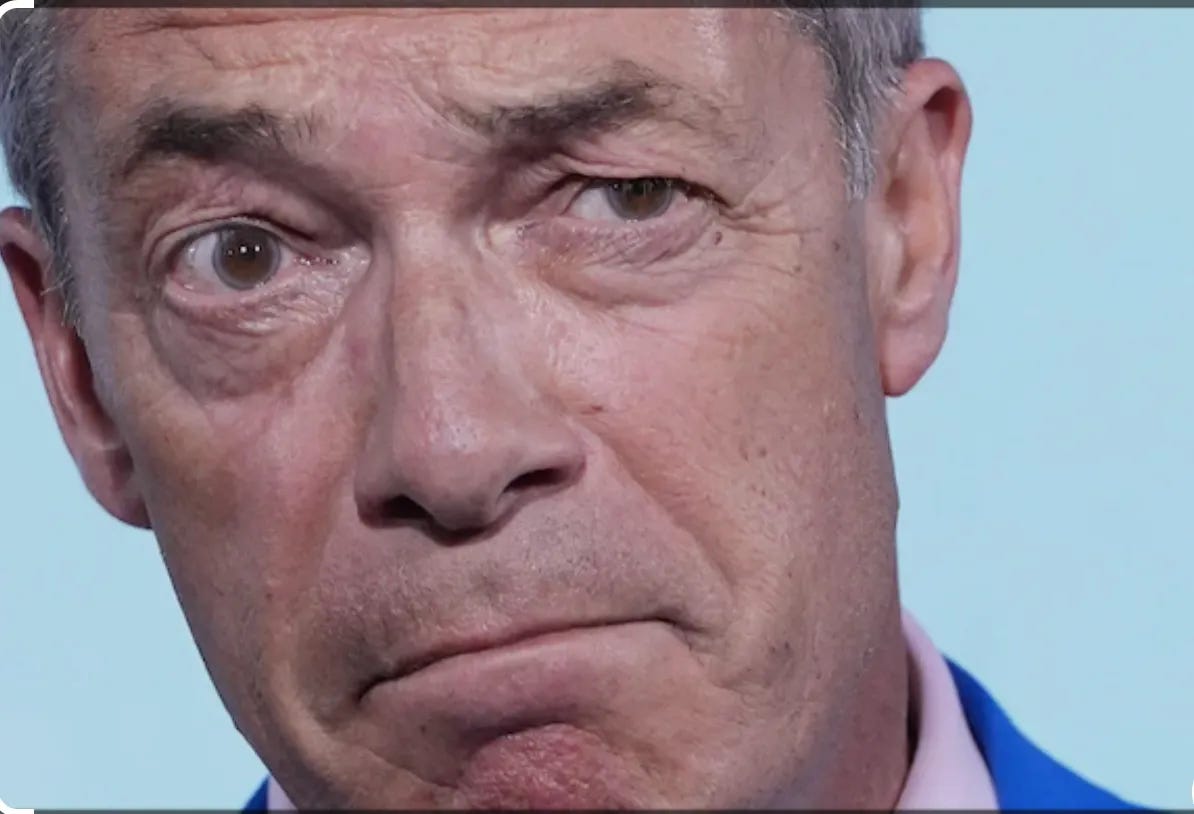
The spark: Farage lets rip, Tice plays follow-the-leader
Nigel Farage announced his resignation as Member of Parliament for Clacton on 7 July, in order to force a by-election in which he intends to stand, to gain a semi-metaphorical vote of confidence from the voters. He is, readers will remember, or rather was until he left the House of Commons, under investigation by the Parliamentary Commissioner for Standards over financial and other donations he has received. His speech, filmed in-house by Reform UK and without any journalists present, was notable, among other reasons, for thread of barely suppressed anger which is unusual in mainstream British politics, or has been for some time.
Of course there are exceptions, and you will find as many examples as you want at marches, demonstrations and gatherings of activists. But in formal, organised, set-piece political oratory like contributions in the House of Commons and speeches at party conferences, it is relatively rare to see politicians suffused with genuine, burning anger.
(Many people have suggested that Farage’s anger was feigned for political advantage. I have no idea if that is true. I don’t like or support Farage, and I thought his claim to be “the most physically and verbally attacked public figure or politician of modern times” was not only foolish hyperbole but positively distasteful given the murders of MPs Jo Cox in June 2016 and Sir David Amess in October 2021, and in light of the recent death of Ann Widdecombe which may have had a political motivation. But I have no way of judging how genuine his anger was, and for the purposes of this essay it doesn’t matter.)
I was prompted to reflect further on this idea when a friend sent me a clip of Reform UK’s Deputy Leader, Richard Tice, being interviewed on GB News a few days ago by Martin Daubney. Tice too is being investigated by the Standards Commissioner for failing to declare in a Westminster Hall debate on pro-Israel influence in UK politics on 22 June that he had visited Israel last September at the expense of a lobby group, Reform Friends of Israel.
He fiercely denies any wrongdoing and has alleged that the investigation is an “establishment” plot, claiming on social media: “I am being investigated for standing against antisemitism. You could not make it up.” Of course, that is not what he’s being investigated for; the Parliamentary Commissioner for Standards is investigating Tice’s allegedly failure to declare a relevant interest. It is unlikely that the Commissioner, Daniel Greenberg, who was raised in an Orthodox Jewish family in Golders Green and habitually wears a kippah, would be party to any kind of antisemitic plot or attempt to suppress those who “standing against antisemitism”.
I digress. The important issue is that Tice was, rightly or wrongly, visibly extremely angry about the matter: when Daubney observed “I can sense your fury”, Tice shouted “Fury? I’m absolutely raging angry. It’s a disgrace!”
I have spent—indeed, still do spend—an inordinate amount of time thinking about politics, and, having spent more than ten years working in the House of Commons, I’m particularly interested in political oratory and rhetoric. (I’m trying to write a book about the poor state of parliamentary oratory but, you know, only so many hours in a day.) The Farage and Tice moments made me reflect on something I’ve long thought: of all the human emotions, of all the registers and attitudes and moods you can try to use or evoke when speaking in public, I think anger is the most difficult and most likely to fail.
Anger is a difficult emotion to exploit
This shouldn’t be a surprise. Anger is a response to unpleasant, dangerous, hurtful or upsetting circumstances and by definition it reflects an uncomfortable feeling. While some of us can benefit from the catharsis of a Malcolm Tucker-style explosive and expletive-laden rant from time to time, the nature of anger is that it is confrontational; not oppositional in the way a debate might be, but spiky and hostile and bitter. We don’t associate anger with reason. Rather the opposite: anger is often perceived as the result of a loss of control: there’s a reason we “lose” our temper, our composure, our cool, our head, our rag, our shit, the plot, control, even just “it”, why we blow our top or fly into a rage or hit the roof or go ballistic. Anger is also a deeply un-empathetic emotion, and where it is shared it can be destructive. Shared anger is the currency of the mob, of gangs, of pogroms and persecutions, and it doesn’t make us think of rationality or persuasion. Instead it summons up, to borrow Charles MacKay’s phrase, the “madness of crowds”.
There is also something about anger which does not readily inspire admiration or respect. It may show is the depths of someone’s feelings, it may frighten, alarm or intimidate us, but, in real life, away from Peter Capaldi’s searing performance in The Thick Of It, we rarely watch someone in a fit of rage and feel impressed or approving. Why would we, other than to marvel at the heat and light of the volcano? Anger is a failure to do something, a failure to remain calm, rational, dispassionate, courteous, considerate. Its very volume can be amusing—Malcolm F. Tucker again—but that leads down a dangerous path: if we laugh at the spectacle of someone’s anger, we can very quickly begin to laugh at them, too.
If there are no others, there is one iron rule in political discourse: if you are mocked and derided, rather than being joined in collegial humour, you have lost, and you are unlikely to recover—perhaps within that debate, perhaps ever. As Sir Terry Wogan, on his eponymous BBC chat show in April 1991, said gently to the preposterous David Icke as the latter tried to engage with the audience, “they’re laughing at you, they’re not laughing with you”. That was the sign that any tiny chance there had been of Icke being given a sympathetic hearing had melted away.
This is not me embarking on some eirenic campaign against outbursts of anger. It’s a natural and inevitable human emotion that even the saints must experience. Christ Himself had flashed of anger, making a knotted rope into a scourge and driving the moneylenders and the livestock sellers out of the Temple in John 2:13-16, shouting after them, “Take these things hence; make not my Father’s house an house of merchandise”.
It is perhaps an unfashionable opinion now, but I wouldn’t even say anger has no business at all being in the workplace. In 11 years as a clerk, only one Member of Parliament ever told me explicitly to fuck off (no, I won’t tell you who it was), I understood that contextually it was not about me but a sudden venting of frustration in slightly pressured circumstances, and it was forgotten. I had (and still have) a perfectly friendly and amicable relationship with the Member involved.
Turning temper to advantage
At a more elevated pay grade, think of Winston Churchill and Field Marshal Sir Alan Brooke, Chief of the Imperial General Staff from December 1941 to June 1946. Churchill, while he possessed many elements of genius, was extremely challenging and frustrating to work for. He had a habit of seizing on half-formed or impractical ideas and embracing them with the stubbornness of a spoiled child, and, although Brooke served more than four years as Chief of the Imperial General Staff—longer than anyone else except the now largely forgotten Field Marshal Sir George Milne, an undramatic Aberdonian gunner known as “Uncle George” who was in post for seven years (1926-33)—he found the role draining.
Brooke was the fourth CIGS in as many years when he was appointed at the end of 1941. General Viscount Gort (1937-39) had been sent to command the British Expeditionary Force when the Second World War broke out in 1939 and did not acquit himself entirely well; General Sir Edmund Ironside (1939-30) lasted less than nine months, having been surprised by the appointment and expecting to command the BEF, and was, to his own relief, moved to be Commander-in-Chief, Home Forces, to prepare for a possible German invasion; and General Sir John Dill (1940-41), after a few weeks as Vice-Chief of the Imperial General Staff, replaced Ironside but could not find a manageable relationship with Churchill and was regarded as unimaginative and obstructive, yet enjoyed huge and influential success when he was sent to be Chief of the British Joint Staff Mission in Washington DC.
Clearly Brooke was vastly more successful than his predecessors but his success was not achieved through tact or sycophancy. He could be sharp and cutting—his diaries excoriate various colleagues up to and including Churchill—and by both temperament and judgement he was able to channel undoubtedly sincere fury into effective management of their relationship. Churchill remarked upon it in astonishment.
When I thump the table and push my face towards him what does he do? Thumps the table harder and glares back at me. I know these Brookes—stiff-necked Ulstermen and there’s no one worse to deal with than that!
(He may have had a point about the Brookes. Sir Alan’s nephew Sir Basil Brooke, later Viscount Brookeborough, was Prime Minister of Northern Ireland from 1943 to 1963, and was an unbending anti-Catholic. At an Orange Order rally in 1933, he had declared:
Many in this audience employ Catholics, but I have not one about my place. Catholics are out to destroy Ulster… If we in Ulster allow Roman Catholics to work on our farms we are traitors to Ulster… I would appeal to loyalists, therefore, wherever possible, to employ good Protestant lads and lassies.
In later life he admitted regretting his choice of words but gave the impression of standing by his underlying argument. In his obituary in The Times in 1973, Brooke’s Minister of Finance and successor as Prime Minister of Northern Ireland wrote tellingly that “he was good company and a good raconteur, and those who met him imagined that he was relaxing away from his desk. However they did not realise that there was no desk.”)
Brooke’s ability to work effectively with Churchill in a way very few other senior military figures did, and for such a long time, and to do so while preserving professional independence and autonomy, was partly based on a kind of emotional return of serve: when the Prime Minister flew into a rage, the Chief of the Imperial General Staff simply met like with like. And it worked. The two men were undoubtedly genuine in being angry, but under those particular circumstances, and relying on considerable personal bravery and self-confidence on Brooke’s part, they were able to turn rage into a positive force.
Undoubtedly Brooke knew this. After one fiery encounter, Churchill had complained to his Chief of Staff, General Sir Hastings “Pug” Ismay, that the relationship with Brooke was doomed, because “he hates me. I can see hatred looking from his eyes.” Ismay discussed this privately with Brooke and explained the Prime Minister’s position. Brooke contradicted Ismay and allowed a brief flash of emotional candour.
Hate him? I don’t hate him. I love him. But the first time I tell him that I agree with him when I don’t will be the time to get rid of me, for then I can be no more use to him.
When told of this, Churchill, famous above all for his ability to articulate and persuade but rarely with conciseness, said simply, “Dear Brookie”.
That mild paean to the productive harnessing of anger brings me to the substantive point I want to make, and to illustrate. There is much, much more to be said about parliamentary oratory (I wouldn’t be in the foothills of writing a book about it if there. were not). For all the caveats, nevertheless, in public, and specifically parliamentary, speaking, anger can be used to advantage, in the way that Churchill and Brooke used it to enable their professional relationship.
If you can keep it under control, make sure it is only ever a tool you deploy rather than an irresistible motive force, anger can illustrate just by tone and manner a depth of feeling that a thousand words never could. I said earlier that it was not an empathetic emotion, in the sense that it is not persuasive. You are rarely converted to someone’s point of view simply by them shouting at you, as every teacher secretly knows. But it can be powerfully resonant. It can show your audience that you are passionately committed to something or deeply affected by it.
Changes in the public mood and behaviour
I was about to go on to say that this is especially important in a country which is famous for its circumspection, its lack of emotion, the “stiff upper lip”: but I wonder. I do ask myself whether that is any more a distinguishing characteristic of the British people. The outburst of emotion seen when Diana, Princess of Wales, died in August 1997, was extraordinary for its lack of restraint and its self-indulgence. I know not everyone holds this view but I found it mawkish, cheaply sentimental, vulgar and, most strikingly, rather selfish: it was an exercise in performative and almost competitive grieving for a public figure who was certainly held in affection by millions; but, to paraphrase Paul McDermott, frontman of the Doug Anthony All Stars, chiding his audience for groaning at a joke about the recently deceased Freddie Mercury, “you didn’t know her”.
The nature of “the British character” is worth its own consideration, but I think it’s worth just noting that we have, rightly or wrongly, come a long way. It is an unimaginable distance from the swooping, doffing cranes of Docklands and the quiet, respectful removing of hats at Sir Winston Churchill’s state funeral in January 1965; through Margaret Thatcher’s finally unsuccessful battle to bend her emotions to her iron will as she left 10 Downing Street as Prime Minister for the final time in November 1990; to singer and presenter Rylan Clark breaking down with a flourish on The X Factor in 2012; and Health and Social Care Secretary Matt Hancock (before his disgrace and fall) weeping on Good Morning Britain as the first vaccines against Covid-10 were administered to patients in Britain at the end of 2020. Celia Walden wrote perceptively about this change on modern manners in The Daily Telegraph on 2022. But this is a subject which deserves fuller exploration on its own.
To illustrate my point, with only brief commentary, I will list five examples from the relatively recent past—well, 41 years, admittedly—of politicians making powerful contributions though which the thread of anger can be seen flashing but which are never overtaken by rage. The first one is below, and the subsequent will appear in separate posts shortly, as including them all on a single post was threatening to become unwieldy. All judgement is subjective but I think the case for the potency of all five is valid and in some of them widely accepted. Readers are as ever free to disagree, but, as the phrase doesn’t go but should, he who writes the Substack picks the words.
Neil Kinnock, Labour Party Conference, Bournemouth: 1 October 1985
Full speech (audio)—Highlights (video)—Transcript
Perhaps the best known of the choices. Neil Kinnock had been Leader of the Labour Party for two years, succeeding Michael Foot after the party’s heavy defeat in the 1983 general election. Previously Shadow Education and Science Secretary, he had never held government office and was known as a left-winger with a flair for oratory, though some found him long-winded rather than persuasive, and the words “firebrand” and “windbag” often squared up to each other. He has won an unexpectedly emphatic victory in the leadership contest, comfortably seeing off Shadow Home Secretary Roy Hattersley, who became his loyal deputy; the other candidates, Shadow Minister for Europe and left-wing Liverpool Walton MP Eric Heffer (see future post), and Peter Shore, the Shadow Chancellor of the Exchequer who had been Harold Wilson’s enfant terrible nearly 20 years before, were nowhere.
The Labour Party was heavily under the sway of its left wing, hardly hindered by the departure of 28 of its more centrist Members of Parliament to join the newly founded Social Democratic Party in 1981. Despite the disaster of Michael Foot’s leadership from 1980 to 1983, many within Labour felt that the problem was the party had not been socialist enough, and Kinnock was perceived as a man of the left when he was elected leader. But, as the party would come to discover, he was also a practical politician with reforming instincts, and he chafed painfully at the impotence of opposition. Kinnock was only 41 when he was elected party leader, and his roots in the mining villages of South Wales—he was born in Tredegar and his father was a miner—gave him an inner passion and certainty about socialism.
At the same time, Militant, a Trotskyist faction within the Labour Party set up in 1964, was growing in power. Between 1975 and 1980, a series of attempts to expel Militant from the party were defeated by Labour’s National Executive Committee, and by 1976 Militant controlled the Labour Party Young Socialists, the party’s youth wing. In 1982, Liverpool District Labour Party adopted Militant’s strategy of proposing an illegal deficit budget and adopted the slogan “Better to break the law than break the poor”. They then won control of Liverpool City Council in May 1983.
The new Leader of the Council, John Hamilton, was on the left but not a member of Militant. The bloc allowed him to assume the position because real power lay elsewhere: 34-year-old Derek Hatton, a former fireman and Militant stalwart, became Deputy Leader. He was brash, glib and articulate, a hard-left factionalist who pardoxically favoured expensive but showy suits, almost as an invitation to confrontation. Welcoming the traditional Merseyside diminutive “Degsy”, Hatton had three great strengths: he could summon up a pithy, punchy quote for media as if it were second nature; he understood the fear, dejection and anger which were deep-rooted in Liverpool because of its steep industrial decline since the 1960s; and he knew which issues played particularly well against Margaret Thatcher’s Conservative government.
The Conservatives had come to office determined to curb overspending by local authorities, and Michael Heseltine, Environment Secretary from 1979 to 1983, had set his sights on giving Whitehall the power to restrict council spending by capping rates. A Cabinet committee concluded it would be a legal nightmare involving measures which might undermine elements of the constitutional settlement; the rating system went back at least to the Poor Relief Act 1601, and had roots in the Tudor period. This recommendation—essentially “Don’t”—was presented to the Cabinet in January 1983.
Thatcher was unmoved. Her revered father, Alfred Roberts, had been a member then Alderman on Grantham Urban District Council, Chairman of the Finance and Rating Committee and Mayor of Grantham in 1945-46; the memory of his being voted out as Alderman by the new Labour majority on the council in 1952 could still move her to bitter tears 30 years later. But this did not translate into a generalised sympathy for local government, and she told Tom King, who had been Environment Secretary for 11 days, to find a workable and legal plan for rate-capping.
With a renewed and dominant majority of 146 after the 1983 general election, it was open warfare. The idea of central government extending its control so far into the purview of local government was opposed not just by Labour and the SDP/Liberal Alliance but by significant sections of the Conservative Party, including former Prime Minister Edward Heath (although as the premier on whose watch the widely loathed Local Government Act 1972 had become law he might perhaps have exercised a degree of circumspection; but it would have been utterly out of character). But Thatcher had the determination and the political ground troops, and the Rates Act 1984 was granted Royal Assent on 26 June 1984.
The act allowed the government to limit the increases in rates individual local authorities made, and, importantly, made provision for prosecution, fining and banning from public office of individuals who acted ultra vires, that is, beyond the powers of the act. The political became potentially very personal. The powers in the act were used against 31 councils—30 of them Labour-controlled—which had stated they would not comply with government taxation and expenditure policies, and 29 of them backed down. Only two squared up for a conflict: Lambeth London Borough Council and Liverpool City Council. Leader of Lambeth Council Ted Knight and 31 other councillors were eventually prosecuted under the act in 1985-86, fined and banned from holding public office for five years. Then there was Liverpool.
The Militant-dominated Labour group which took control of Liverpool Council from the Liberals in 1983 inherited a draft budget which it estimated was £25 million short of meeting the commitments it had made during the election campaign. This was not pocket change, equivalent to a sum of the order of £100 million now, and comfortably more than a tenth of the council’s overall budget. Several times an illegal budget was proposed, but with opposition from some Labour councillors the leadership could never quite get it approved. The atmosphere, howver, was becoming polarised and poisonous, and once the Miners’ Strike began in March 1984, the political weather was darkening and tempers were rising.
In July 1984, councillors from a number of authorities met in Sheffield to discuss he most effective ways to oppose the government and force Thatcher into retreat. It begins to resemble a prequel to Tony Blair’s New Labour, albeit with a lot of ideological miles yet to be covered in some cases: convening the group was the Leader of Sheffield City Council, David Blunkett; in attendance were the Leader of the Greater London Council, Ken Livingstone, and the Deputy Leader, John McDonnell; Margaret Hodge, Leader of Islington Borough Council; Greenwich Borough Council Leader John Austin-Walker; and the Shadow Environment Secretary, Dr Jack Cunningham.
However the issue was parsed, however grandiloquent the oratory and sincere the moral outrage, the response to rate-capping came down to two options: reluctant Labour council could shout, scream, protest, appeal to the court of public opinion and then negotiate the best settlement possible to minimise spending cuts; or councillors could break the law. Blunkett, not only the host of the conference but Chairman of the NEC’s Local Government Committee, said that “collective action, achieving Government retreat, and not martyrdom, is the objective”. Most councils came sadly to the same conclusion.
In Liverpool there were other ideas. Having gained nine seats on the City Council in 1983, the party won another seven in 1984, giving them 58 of the total 99 councillors. At the 1983 general election, Terry Fields, a Militant supporter, had been elected MP for Liverpool Broadgreen with a majority of 3,800 in a new seat with a nominal Conservative majority of 565. The council launched an ambitious Urban Regeneration Strategy in 1984, cancelled 1,400 planned redundancies and created 1,000 new jobs.
In 1985, the council went on the offensive. On 14 June, it approved an illegal budget and demanded that the government should make good the gap between sending and income. In late August, the District Auditor, John McMahon, advised councillors that the council was shortly to be in breach of its legal obligations, and that by December it would be unable to pay staff wages. Labour councillors responded with a technique to delay and increase pressure on the government: 30,000 council workers received 90-day redundancy notices, and with them a covering letter signed by Hamilton and Hatton explaining the council’s intentions.
Obviously the steps we have had to take will cause concern and worry. However, this course of action provides the only way of providing wages and salaries until 18th December, 1985. Other steps would certainly result in the immediate cessation of payments and the cutting of services… Furthermore, this course of action gives the Government three months to negotiate with Labour representatives a just settlement to our financial crisis. If the Government recognises its responsibility then all notices will be withdrawn.
The council did not intend to make anyone redundant. But council employees, terrified by the prospect of being out of work, did not all appreciate every nuance of the council’s tactics.
The Labour Party’s annual conference then met at the Bournemouth International Conference Centre on 1 October 1985. However, high passions were running on Merseyside, and however iron-clad the self-belief of people like Hatton might be, Kinnock knew these kinds of intricate, high-stakes battles were anathema to a voting public which made up its mind about issues quickly and often irrevocably. He also knew that every week and month that went past with Militant rampant and beyond control, the weaker his position as party leader looked.
In June 1984, Labour had begun to edge ahead of the Conservatives in the opinion polls, but slipped back to second place by September. In March 1985, Kinnock’s party took the lead again, and it began to look like a sustainable, if narrow, advantage: six-and-a-half per cent at one point on March, between two and four per cent in May, one eight per cent lead in June, solidly between four and six per cent through July and August. Then something went wrong. In September, the Alliance suddenly rallied and pushed to the front of the polls, the Conservatives dropping to third in a tightly bunched field.
The next general election was not due until the summer of 1988 at the latets (in the end it was held in June 1987). Although the SDP/Liberal Alliance had suffered badly in the first-past-the-post electoral system in 1983—it was only 2.2 per cent behind Labour in the popular vote but was rewarded with 23 seats to Labour’s 209—it had clearly not gone away and remained a theat. Thatcher, meanwhile, had rallied from, far worse polling setbacks than this. Kinnock might be approaching an inflection point: after two years it was plausible to judge whether he had performed effectively as Leader of the Opposition, with still plenty of time for a replacement to bed in before a general election. If Shadow Foreign Secretary Denis Healey, turning 68 that year, had missed his chance at the leadership, then Roy Hattersley, Deputy Leader and Shadow Chancellor, was a plausible figure, as was Shadow Trade and Industry Secretary John Smith. Peter Shore, Shadow Leader of the House, was quirky and had performed abysmally in the 1983 leadership contest but was still only 61 (although later in 1985 he would fail to be re-elected to the Shadow Cabinet). His experience was hard to match, as he had shadowed environment, foreign affairs, Treasury and trade and industry since 1979, had served between 1974 and 1979 as Trade Secretary and Environment Secretary, had first joined Cabinet in 1967 and as Harold Wilson’s Parliamentary Private Secretary had drafted Time for Decision, the manifesto on which Labour had won a huge majority in 1966.
And Kinnock was genuinely, morally angry. His father had advised him on his election to the House of Commons for Bedwellty in 1970, “Remember Neil, MP stands not just for Member of Parliament, but also for Man of Principle”, Having been Michael Foot’s Parliamentary Private Secretary in 1974-75 when Foot was Employment Secretary, he had seen the inner workings of government but he had turned down offers of ministerial posts from Harold Wilson and Jim Callaghan, and had been a stern critic from the left of the Labour government. He also edited a collection of speeches and writing by left-wing icon Aneurin Bevan, born like Kinnock in Tredegar, entitled As Nye Said, which was published in 1980.
Bevan had bowed to no-one in the strength of his socialist feeling, and was as much of an ideological socurge as anyone on Labour’s left. But Bevan’s greatest achievement in the public mind was the passage of the National Health Service Act 1946 leading to the establishment of the NHS on 5 July 1948. But he had only been able to do so by accepting Clement Attlee’s offer of the post of Minister of Health in 1945, having spent his preceding 16 years in Parliament on the backbenches, clashing with his party leadership and assailing with vitriol almost anyone anywhere in the House who crossed his path.
When Kinnock had been elected party leader in 1983, his acceptance speech contained a significant passage.
If anyone wants to know why we must conduct ourselves [with common sense and realism], just remember at all times, with all temptations, how you, each and every one of you sitting in this hall, each and every Labour worker watching this conference, each and every Labour voter, yes, and some others as well, remember how you felt on that dreadful morning of the tenth of June. Just remember how you felt then, and think to yourselves: “June the ninth, 1983, never ever again will we experience that”.
This was the spirit burning inside him when he took the platform on 1 October. Party conferences then were not the smoothly oiled and minutely organised public relations opportunities they are today, particularly Labour conferences which had a formal role in policy making. Denis Healey’s speech to the 1976 conference in Blackpool, explaining and defending his application to the International Monetary Fund for a loan, had resembled a bear pit, with the Chancellor of the Exchequer bellowing over critics trying to shout him down (there was no shouting Denis Healey down).
He knew it was the time. Moving against Militant in 1984 had been impossible because of the Miners’ Strike, but Liverpool City Council’s illegal budget offered a field of battle, and the issuing of redundancy notices was the spark. When Kinnock learned about the notices in a newspaper, his words to Charles Clarke, then his Chief of Staff and 20 years later Home Secretary, encapsulated both his burning desire to take on and defeat Militant and his fury at what the group was doing to the Labour Party.
I got the bastards. I got them, I got them. This is where it stops.
This was Kinnock’s ne plus ultra moment. It was perhaps the best speech of his career, and, having watched it many times, I am convinced it would have lacked its power had Kinnock not let his anger show. He had to shout despite the microphones because heckling from the floor—Derek Hatton shouted “Lies!” repeatedly, though it is hard to find a material inaccuracy in his text—but when he reached his peroration, he was in full Bevan-like moral fervour.
I'll tell you what happens with impossible promises. You start with far-fetched resolutions. They are then pickled into a rigid dogma, a code, and you go through the years sticking to that, outdated, misplaced, irrelevant to the real needs, and you end in the grotesque chaos of a Labour council—a Labour council—hiring taxis to scuttle round a city handing out redundancy notices to its own workers… I am telling you, no matter how entertaining, how fulfilling to short-term egos—you can’t play politics with people’s jobs and with people’s services or with their homes.
The speech demonstrated both Kinnock’s determination and his disgust. It put Militant on notice, advised its members they had gone too far; and in 1986 he saw that Hatton and eight other leading figures in Militant were expelled from the Labour Party. Kinnock had scored an important victory.